
Nobody on your team is being difficult on purpose.
They’re operating a program they didn’t choose and can’t see — one written long before they ever joined your org chart. The People Puzzle™ team experience makes it visible in half a day, so your team stops managing personalities and starts understanding people.
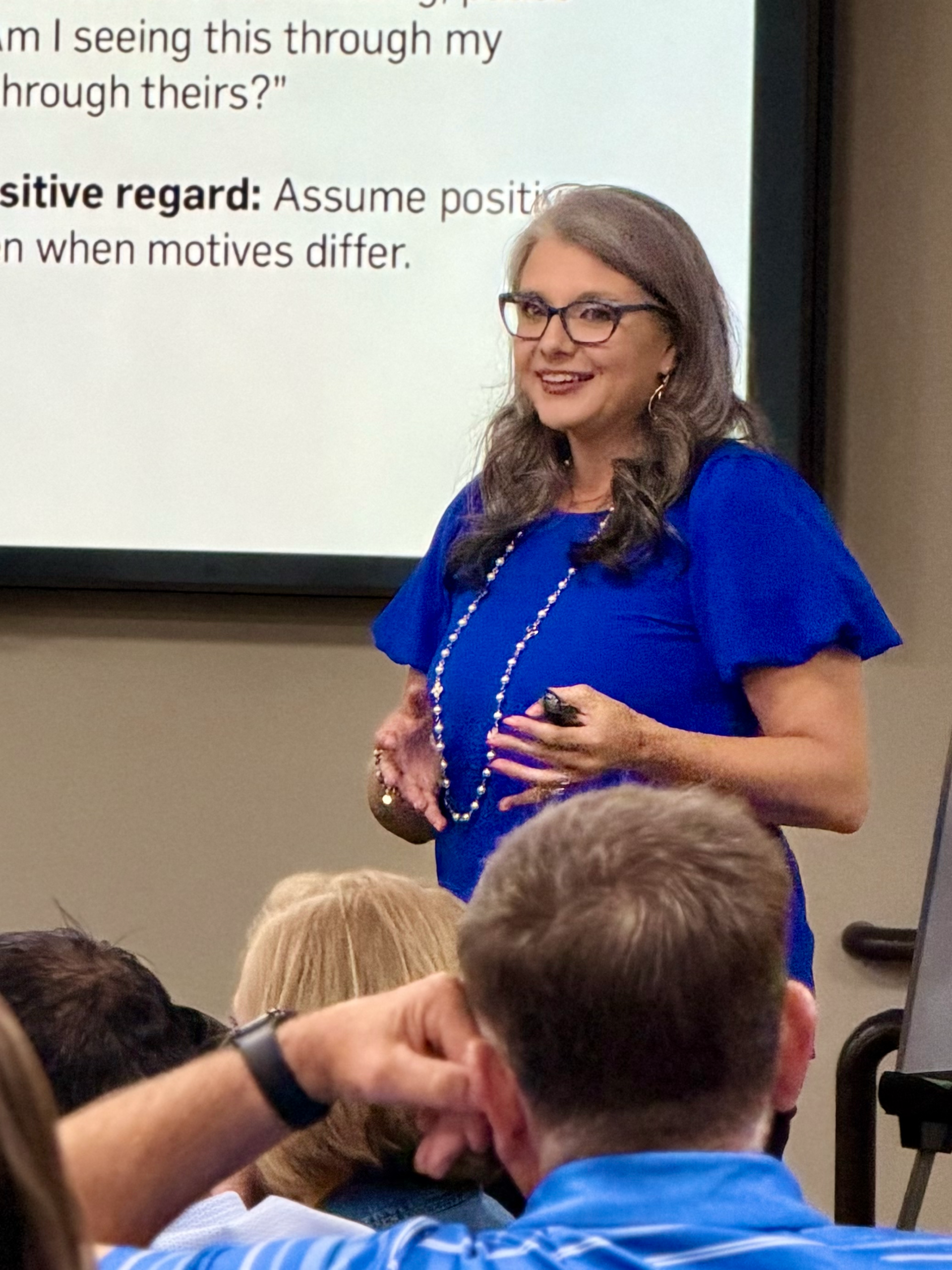
You already know what your people do. Almost nobody knows why.
Perceptions become reality. But everyone’s perceptions vary. So who’s right?
Every one of these sentences has been said about someone on a good team, by someone who meant well. Turn each one over and the difficult coworker disappears — a real person shows up instead.
Four cards. Four people. Your team is carrying dozens more — every behavioral style crossed with every way of connecting, in every combination sitting around your table. We spend the session finding yours.
“Nobody has ever changed because they were finally labeled correctly. People change when they’re finally understood.”
And that understanding doesn’t disappear at five o’clock — whatever that team member finally sees about himself in your staff meeting is the same thing he’s been carrying to his own kitchen table for years.
Half a day. Not one minute of it is a lecture.
Everyone walks in having already taken the Relationship Intelligence Profile™, so we skip the setup and start with the work. The order matters: nobody can flex toward someone else until they’ve seen themselves clearly first.
Why nobody’s being difficult
We put the premise on the table: behavior is the visible end of something much older. No icebreakers, no trust falls — just the first honest conversation about why the same team keeps having the same three arguments.
Your style, out loud
Each person’s DISC results in their own words — what their lead style buys them, and what it quietly costs. The room starts recognizing each other fast, and the laughter that shows up here is the sound of people feeling seen rather than judged.
The part underneath
Attachment — how each person learned to connect, and why that’s the engine running under the behavior everyone else sees. This is the block people are still talking about a year later.
Break
Coffee. And the hallway conversations that start here aren’t a side effect of the day — they’re half the point of it.
Reading the room
Flexing toward the other three styles — with the colleague across the table and the client on the phone. This is practice, not theory: real scenarios from your actual work, run out loud.
Conflict without casualties
What each style does under pressure, what each attachment does when it feels unsafe, and how to stay in the conversation once the temperature rises — instead of winning it, or leaving it.
The owner’s manual
Everyone writes the card that tells their team how to get the best of them — what they need, how to say hard things to them, what helps when they’re stressed. Then they trade. Nobody leaves with a takeaway they have to remember; they leave with one they can hand to someone.
On-site or virtual. Best with 8–30 people — if your group is smaller or bigger, or you want several teams in the same room, ask and we’ll figure out what works best. And if something specific is going on with your team right now, tell me beforehand and I’ll build the day around it.
Ask about your team
- Certified Professional Life Coach — ICF-accredited program
- Certified DISC facilitator
- Certified Core Strengths SDI 2.0 facilitator
- Creator of the Relationship Intelligence Profile™
- Former Supply Chain Transformation Team Lead, U.S. Army Materiel Command
- Designed and led a corporate leadership coaching program
Finding the missing piece of the relationship puzzle
I’ve led a supply chain transformation effort for the U.S. Army across four commands. I’ve designed and implemented a leadership coaching program. I’ve run team sessions with DISC and with Core Strengths SDI — and I’ve watched a room light up at 10 a.m. on a Tuesday and be right back to normal by Thursday.
That bothered me for years. The tools were good. People enjoyed them. There was some revelation, but nothing really changed. Eventually I understood why: These assessments can tell your team what they’re doing to each other. But they can’t tell them why — and why is the only part anyone can actually work with to create real, lasting change.
I knew that because I’d been the exhibit. For twenty years I ran one strategy, and it worked beautifully — right up until it didn’t. The weight of the people-pleasing finally crushed me.
Be useful. Be needed. Never be a problem. It served me for two decades, and I couldn’t see it until it stopped.
Every assessment I’d ever taken described that behavior back to me and called it a personality.
So I built the one that goes a question deeper. Why?
The Relationship Intelligence Profile™ reads behavioral style and attachment together, because the behavior your team sees and the reason underneath it are two different things — and only one of them ever changes anything.
That’s my focus now. It still gets me — the eyebrows lift, and then the shoulders come down. That’s the whole thing right there: somebody finally sees why they are the way they are, and that they’re not in trouble for it. I don’t think that will ever get old.
If your team is tired in a way nobody can quite figure out, it’s probably not a problem to manage. It’s a few good people who’ve never felt understood.
The longer version — the faith, the family, the fallout, and the future; is over here →
Here’s what people are saying.
Real reactions from recent The People Puzzle™ participants.
Jamie gets down to the root of what drives us and what motivates us — and often it isn’t for reward, but what we’ll do to minimize stress. The actions we portray are often behind that. We are complex beings, and just a little understanding of each other and what drives us can go a very long way!Joseph S.Supervisor, 20+ years in supply chain management
Jamie really understands the material and has a true passion for the topic. She is a rock star when it comes to understanding people and relationships.LauraSupervisor, supply chain operations
More Feedback
Considering this session for your team?
Do it.Joshalyn W.
Go for it.Ben
Excellent choice.Bianca
One half day. Everything included.
No per-person assessment fees, no materials line item, no surprises on the invoice. One number, everything in it.
- 3.5 hours of facilitation — on-site or virtual
- The Relationship Intelligence Profile™ for every participant
- A personal report each person keeps
- The owner’s manual each person writes — and trades
- A pre-session conversation with you, so the day fits your team
Travel outside the Huntsville, AL area is quoted separately. Tell me a little about your team and what’s going on with them, and I’ll tell you honestly whether this is the right room for it.
Ask about your team